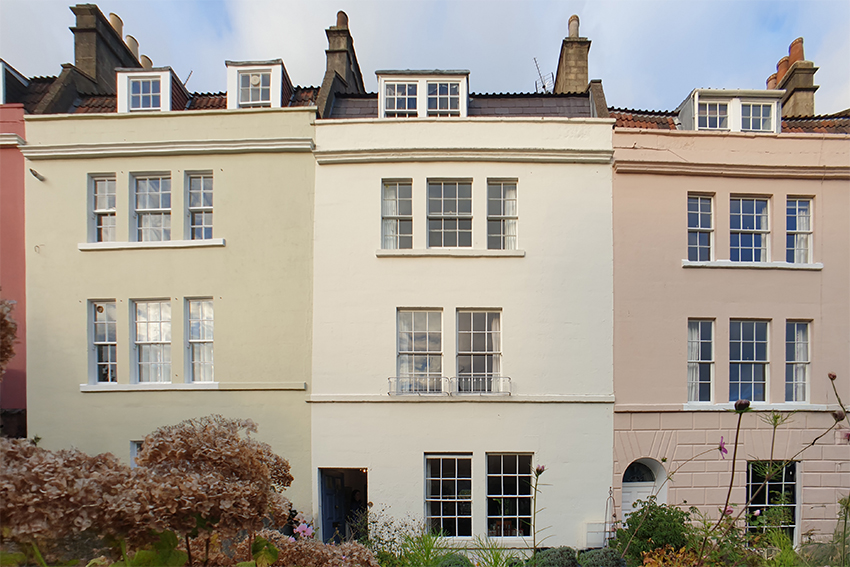
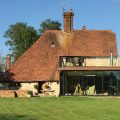
Living or working in historic buildings like a Listed terraced house in Larkhall in Bath or this spot-listed farmhouse in Tytherington (above) may seem to rule out Eco-Refurbishment but there are still many changes that can be acceptable for Listed Buildings.
Some fall into ‘de minimis’ category, requiring no Listed Building Consent. But be warned, altering a listed building without consent can be a criminal offence, so never assume – ask! Listed Building Officers hold many different opinions about what’s acceptable change in our historic buildings so its often worth making a Listed Building Pre-App – despite the fee involved! Indeed BaNES are offering a reasonably priced Level 0 Pre-app specifically advising on how you can improve the energy performance of your listed building.
In order of eco-cost-effectiveness:
Draughtstrip windows, doors, loft-hatches and service entries. Insulate roofs, floors and walls in that order.
At the farmhouse above, we had to prove that its external rendering was all ‘modern’ cement-based before we were allowed to strip it, insulate the walls with cork slabs and re-finish them with lime render.
Upgrade windows with clear roller blinds, shutters, thermal curtains or secondary glazing.
For new windows, you may be allowed double glazing – but don’t assume so.
In recent years more Listed Building Officers have begun to accept – even welcome – the alternative of vacuum glazing, with performance better than triple glazing and appearance so much better than secondary glazing. For large panes costs are reasonable but for small panes they’re steep since every pane has to be individually made; ‘applied’ glazing bars can be a more economicaloption but is not always permitted.
Upgrade your heating controls with TRVs at least and then with zone controls and weather compensation so that unused areas of the building are not wastefully heated and so that our changeable weather patterns are accounted for.
As far as ventilation is concerned, once buildings are thoroughly draft-stripped, adequate venting becomes more critical and with multiple bathrooms, kitchens and utilities, heat reclaim systems are increasingly viable; current systems can be over 90% efficient in reclaiming heat with very low power fans. However, the complexities of installing the necessary ductwork for these systems can rule them out of all but the most comprehensive refurbishment. Individual reclaim fans may be an alternative though they’re much bulkier.
If boilers need replacement, consider heat pumps – ground or water source ideally or air source – all need to work with underfloor heating or very large radiators to be efficient. The reverse cycle versions can provide cooling as well to help cope with our hotter summers. They come at a high capital cost (even with the grant) but long life and trouble-free. Alternatively, clean burn biomass – logs, wood pellets, straw etc – for lower cost but higher workload. Solar thermal or solar PVs can be acceptable for a ‘discreet roof slope’ or perhaps at ground level but freedom from shade – trees, roofs, chimney stacks etc – is critical, especially for PVs. At Tytherington, its south roof pitch had been re-tiled with concrete tiles prior to its spot Listing, so our enlightened Listed Building Officer welcomed PV panels instead. Solar energy needs to be combined with storage for best value – high volume thermal stores for solar thermal or PVs; battery installations for widest use and car charging: they need space of course but are likely to count as ‘de minimis’ in your newly comfortable Listed Building.